Visual Package Manager



Overview
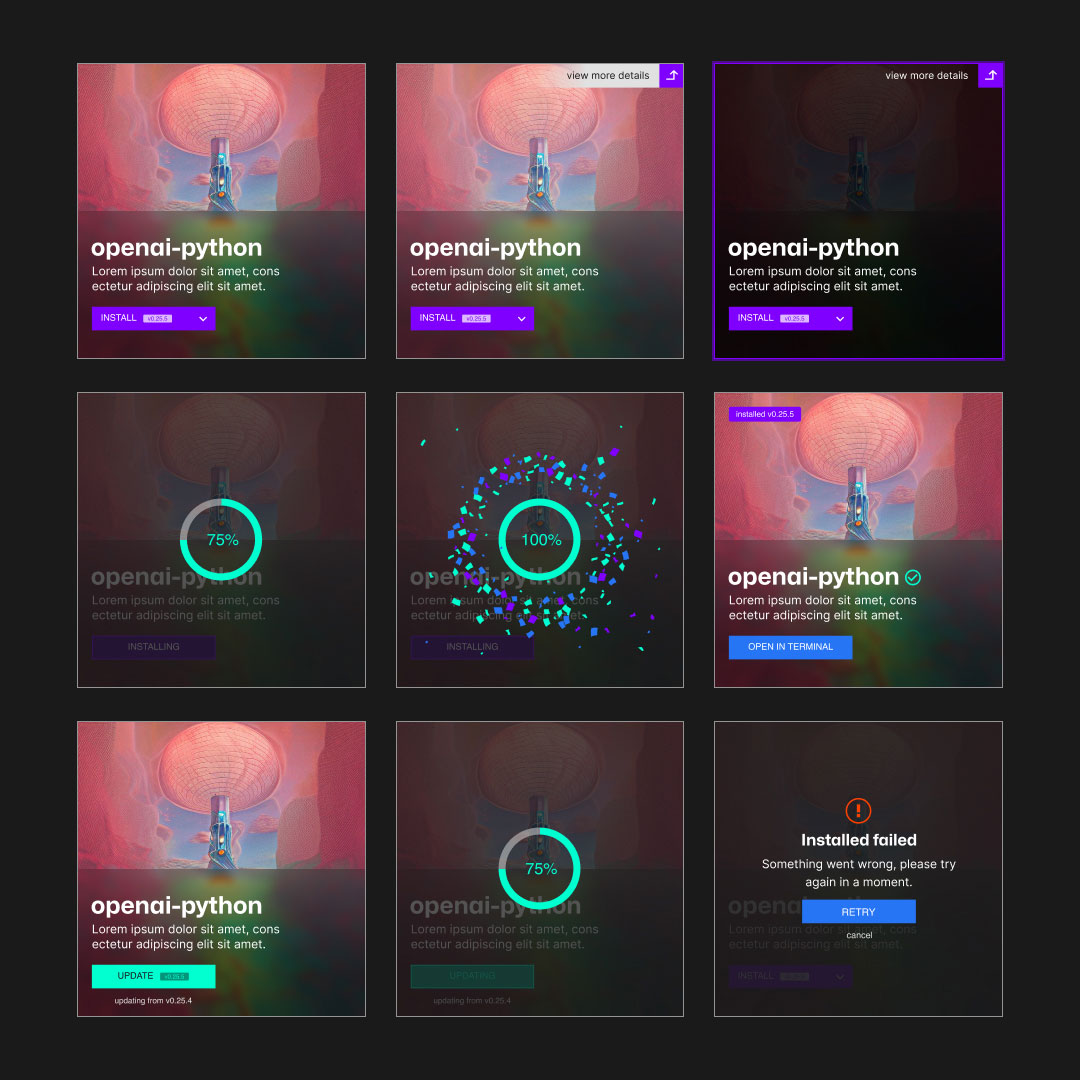
What would a developer's terminal look like in the form of a gui (graphic user interface)? That's the question we asked ourselves when designing PKGX's visual package manager, now called the OSSAPP. The goal was to create an app that would empower anyone to to install and manage open-source software. Users are able to visually browse open-source that's available on PKGX, install and uninstall, manage versions, interact with an in-app terminal (and gui when available), and much more. I led all aspects of the design, owned the prompt engineering for AI-generated package imagery, and assisted with the frontend development. Uniquely, every component was 100% designed from scratch.
- UI/UX Design
- Product Design
- Figma
- Prompt Engineering
- Art Direction
- Creative Direction
- Entrepreneurship
- Stable Diffusion
- Automation Development
- Frontend Development
Background
The OSSAPP was originally developed under tea.xyz before being re-branded to OSSAPP (Open-Source Software App) under PKGX, and it's now one of PKGX's flagship products. Internally, we simply called it the 'gui'. The terminal is such a powerful tool that everyone has access to, but only seasoned developers know how to wield. We wanted to bring casual users into the fold and introduced open-source to a wider user-base. In effort to assign a visual identity to these pieces of code which previously only existed as such, I developed a custom AI-prompt and we engineered an automation to generate a graphic cover for each package when added to PKGX. We launched on ProductHunt and were were instantly lauded by the developer community. Users praised the UI in particular, citing that it was refreshing to see something not made form cookie-cutter components.
The Challenge
Aside from the custom components, the aspect of this project that I'm most proud of is the AI workflow that we developed for image generations. I engineered the prompt for Stable Diffusion, and then worked with our development team to create an automation wherein an on-brand image would be generated each time open-source developers submitted their packages to PKGX. A key aspect of this workflow was that it sent image previews to Slack where I could either approve the generation, or request another image. This enabled us to workshop the prompt over time, and also add negative prompts to steer the AI away from anything profane or repetitive. The ever-changing capabilities of AI also created a moving target for us. As the AI got better and better, it became necessary to adapt the prompt accordingly so as to ensure that the images remained consistent.